
Digital and Environmental Transition: the complexity of the twin transitions
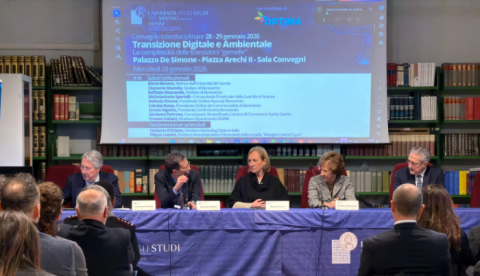
Two Days of Dialogue Among Academics, Institutions, and Business Leaders
The interdisciplinary conference “Digital and Environmental Transition: the complexity of the twin transitions” opened today in Benevento, at Palazzo De Simone. The event is promoted by the University of Sannio – DEMM Department. Structured over two days, the conference brings together academics, institutional representatives, and business managers to engage in discussion on the key challenges of the dual digital and environmental transition.
“The digital and environmental transitions raise complex questions that require rigorous research, interpretative capacity, and continuous dialogue among different disciplinary fields,” stated Maria Moreno, Rector of the University of Sannio. “It is the role of the University to promote interdisciplinary approaches capable of integrating economic, legal, technological, and social expertise, providing analytical tools and interpretative frameworks to support the processes of change affecting territories and society.”
Ernesto Fabiani, Director of the DEMM Department, also addressed the scientific framework of the conference, emphasizing the value of interdisciplinary dialogue: “This conference stems from the Department’s commitment to fostering interaction among different bodies of knowledge in order to address the challenges posed by the twin transition in a non-sectoral manner. Digital transformation and sustainability cannot be examined separately; they require integrated approaches capable of combining legal, economic, organizational, and social dimensions.”
During the first day, within the session dedicated to labor, enterprise, and finance, Umberto D’Oriano, Marketing Director of Optima Italia, delivered a contribution focused on the integration of energy, telecommunications, and digital services as a lever for process simplification and efficiency improvement for businesses, households, and Public Administration. “The twin transition requires, first and foremost, a strong capacity to govern complexity,” observed D’Oriano. “Service integration can foster more efficient systems by reducing waste and indirect costs and by promoting more responsible use of resources.”
The discussion highlighted the challenges generated by the convergence of technological innovation and environmental sustainability, underscoring the need for industrial and governance models capable of supporting ongoing transformations, with particular attention to economic sustainability and the rational use of resources.
The conference was also attended by the Mayor of Benevento, Clemente Mastella, who emphasized the strategic importance of the digital and environmental transitions for the future of Southern Italy, highlighting the role of universities as hubs of knowledge, research, and education in support of local territories. “Digital technologies, the environment, and energy represent an extraordinary opportunity for development in the South,” stated Mastella. “Universities can guide territories toward new models of work, growth, and quality of life, helping to strengthen their competitiveness.”
Organized into several sessions dedicated to law, labor, finance, territories, culture, and innovation, the conference will continue tomorrow, reaffirming the role of academia as a space for dialogue among institutions, enterprises, and local communities on issues of development and sustainability.