
A research group at UNISANNIO proposes a new solution to a paradox in quantum mechanics raised by Einstein.
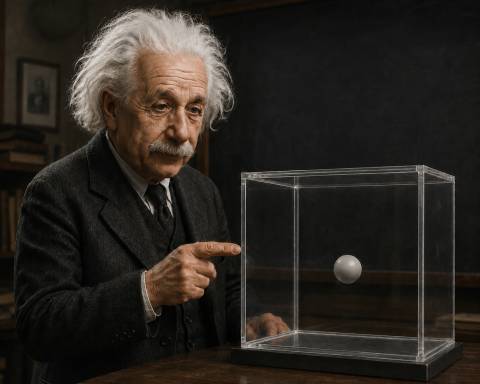
New findings from the research group led by Professor Antonio Feoli at the University of Sannio have recently been published. The study concerns a possible solution to a problem raised by Einstein in 1953.
In an attempt to demonstrate that quantum mechanics is an incomplete theory, Einstein considered the motion of a body confined within a box with reflecting walls. He pointed out that classical mechanics describes the body as undergoing oscillatory motion, whereas the equations of quantum mechanics predict that the body remains stationary. Several scientists have attempted to justify this paradoxical prediction in different ways. By contrast, Antonio Feoli, Elmo Benedetto, and Alessandro Cesta have shown that, using the standard rules of quantum mechanics, it is possible to obtain a solution to the equations that allows for the oscillatory motion required by Einstein.
The three researchers developed a model applicable not only to a particle in a box, but also to several other well-known cases in quantum mechanics, such as a bouncing ball and quantum tunnelling. The mathematical model provides an expression for the particle's velocity, calculated using a formula that directly corresponds to the one used in classical mechanics. The latest article on this topic was published in the international journal Modern Physics Letters A in 2026.